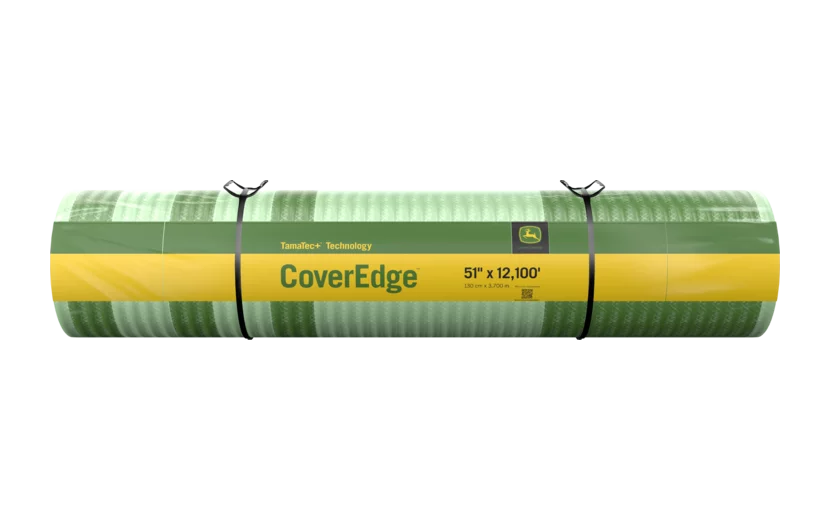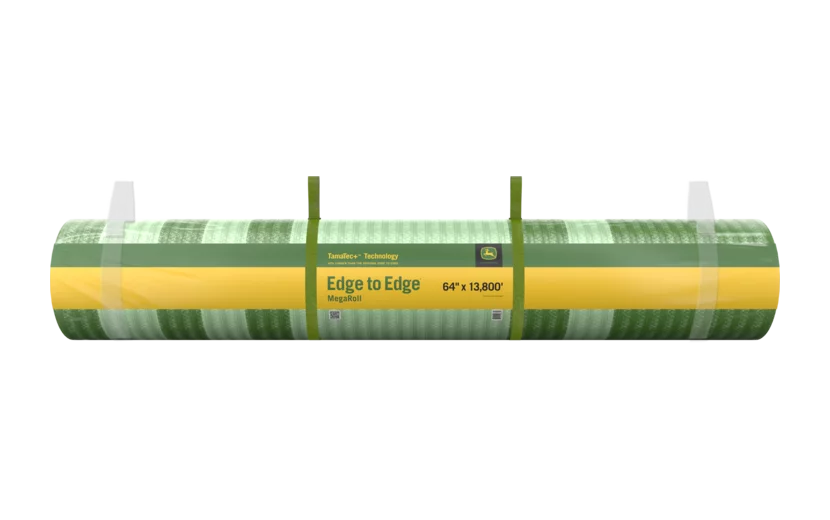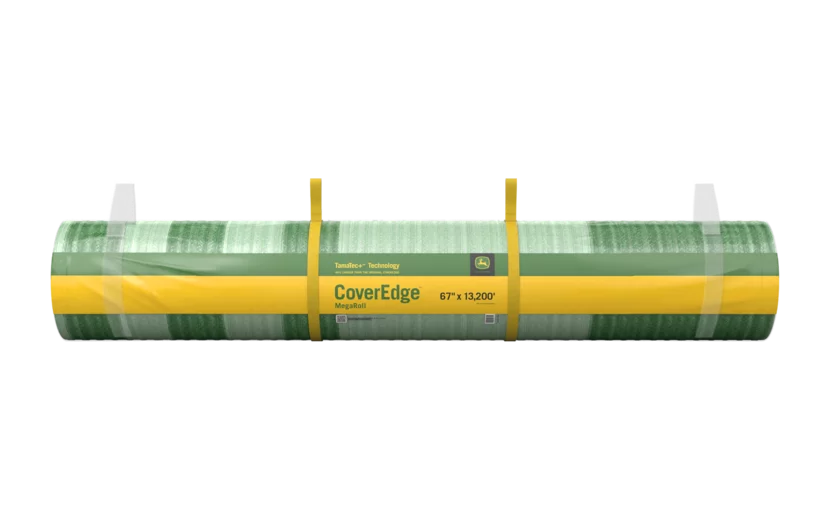

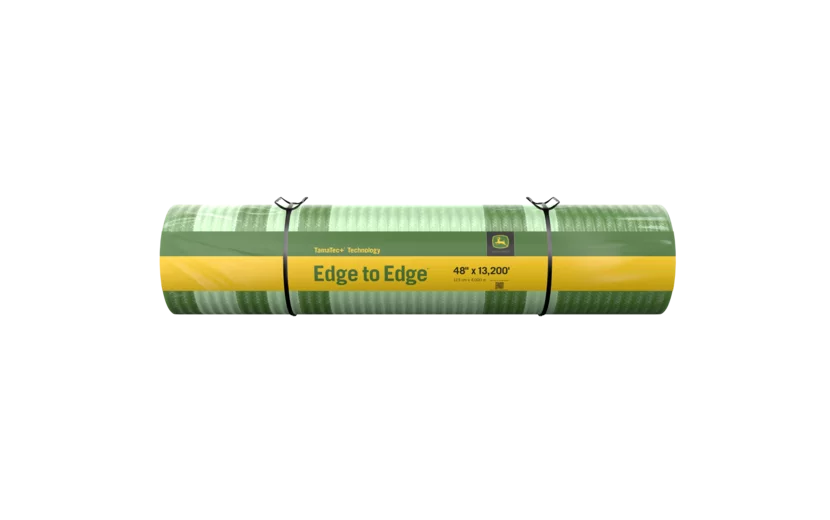
John Deere Edge to Edge TT+

64" x 9,700 FT MINIMUM GUARANTEE48" x 13,200 FT MINIMUM GUARANTEE

John Deere Edge to Edge® is specifically designed for your John Deere baler, ensures the perfect baling experience. It offers more bales per roll, superior crop protection for longer-lasting bales, and a lower cost per bale. With increased footage per roll, achieving 10-15% more bales per roll, John Deere Edge to Edge® enhances baler productivity and reduces downtime.
Edge to Edge was designed for 5 and 6 Series balers. It can also be run in newer balers as well.

Features & Benefits

ZEBRA® System

A unique striping pattern with clear 'left/right' indicator.

Roll Carry Handles

Fitted for increased safety and convenience during transport and handling.

Guaranteed minimum length

Each roll contains AT LEAST the exact stated length.

Roll End Warning

Every roll contains a visible Roll End warning stripe, which shows the end of the roll is approaching.

In-Field Support

We're here to help tackle any problem. Our experts are available to offer technical support whenever you need it.

Roll ID

Each roll includes its own unique "passport", enabling the tracing of complete production details.

Technologies

TamaTec+

A unique combination of advanced raw material with a special manufacturing process for: Length: Maximum roll length for non-stop baling Strength: Unrivalled performance even under the most extreme baling conditions Weight: Amazing length and strength within a workable roll weight Consistency: Uniform consistency for hassle-free operation.
Play Pause

Edge to Edge® Technology

Keeps the net wide as it feeds onto the bale, covering it completely. This protects your crop and maintains the bale's shape, reducing crop loss and making storage simpler.
Play Pause

Specifications

Product Name Length Width Diameter Rolls per Pallet
John Deere Edge to Edge TT+
13,200 FT MINIMUM GUARANTEE
48"
11"
16
John Deere Edge to Edge TT+
9,700 FT MINIMUM GUARANTEE
64"
9.8"
12
Product Name
Length
Width
Diameter
Rolls per Pallet
John Deere Edge to Edge TT+
13,200 FT MINIMUM GUARANTEE
9,700 FT MINIMUM GUARANTEE
48"
64"
11"
9.8"
16
12

2 Products


Map Title

Choose Your Category

Results Text (0) View All Experts Text

More ways we can assist

Service request Icon

Service request

Knowledge Center Icon

Knowledge Center

Training Icon

Training

Field experts Icon

Field experts

Questions about Netwrap?

We’ve got the answers
Netwrap Knowledge Center

Questions about

Netwrap Knowledge Center
Netwrap Baling Tips
When using Round Bale Netwrap, a few moments must be taken to ensure correct preparation of your machine in order to achieve the best results. The most common problems of net splitting, tearing, or fouling on feed rollers arise from the net ‘laddering’, where threads become broken, leading to a running stitch in the net running opposite to the direction of the net, eventually causing the net to separate where the ‘ladder’ has occurred. This can be caused by many different and varying circumstances but will always have the same ‘ladder’ effect.
Check that the area in which the roll sits is free from dirt and debris. Ensure that all metal surfaces the net comes into contact with are free from rust or sharp edges or weld spots (net box sides, spreader bars and rollers etc.), or dried paint ‘lumps’ on any surfaces which could damage the net. Clean up with emery paper if necessary. Also, check that the path for the net to the bale behind the feed mechanism is not dirty or rusty, which could restrict the net’s passage when feeding – often identified by a ‘lump’ of net at the start of the wrapping cycle. This is especially important when starting baling after winter storage.
Ensure the net is threaded correctly. Incorrect feeding of the net will cause incorrect tension being applied, leading to feeding and cutting difficulties which, in turn, will cause problems on subsequent net feed cycles. Where the net is fed through a series of fixed tension bars, always make sure these are clean and polished to avoid excessive friction. Excessive net friction or an uneven surface will cause the net to tear.
Where two rollers are used to feed the net, it is imperative these are correctly aligned and tensioned against one another, to enable the net to feed in evenly and under the correct tension. Incorrectly aligned rollers will produce a corresponding uneven net feed and subsequent cutting action at the end of the wrapping cycle. This will result in poor bale coverage and possible net fouling on the feed rollers at the start of the next cycle. The rollers’ surface should also be closely inspected for abrasions or damage, which could snag the net when feeding.
Ensure the feed rollers are clean of any moisture or residue. Never use an aggressive cleaning agent such as petrol or turpentine to clean rubber rollers.
Always dust rubber rollers down with French chalk or talc powder when loading a new roll of Netwrap, or use anti-static spray to reduce net static when operating. This avoids the net fouling and wrapping around the rollers when feeding in.
Carefully inspect the condition of the belt joiners on variable chamber balers for damage or worn connections, as this will snag the net and cause a tear, which will split the net on the bale.
Make sure the knife or cutting surface is clean and undamaged. Poor cutting action will result in an uneven ‘tail’ to the net, which can become tangled in the rollers and feed mechanism.
What is the length of the net?
How many bales can be made from one roll of netwrap?
Is the net strong enough?

More Farm-Grown Must-Haves

Discover other products of interest

Skip to content